Tuesday, June 28, 2016

Feelin' Lucky: June 2016

Feelin' Lucky: June 2016

     "Feelin' Lucky" is a series of blogs posted on a monthly basis with the help of the folks at Lucky Tackle Box.  The point of these posts are two-fold; I'll be discussing a bit about Lucky Tackle Box, a great company that sends out subscription boxes filled with tackle each month from established tackle makers, along with some up and coming small businesses making their way into the fishing industry.  Secondly these posts act as in-depth fishing reports for the particular lake I go to each month.  Hopefully you and I will each learn something new along this endeavor.

Lake Havasu:  I was extra excited for June's Feelin' Lucky project.  This month I met up with a great group of U.S. Veterans for a kayak fishing event put on by Heroes on the Water Arizona Chapter.  HOW is a fantastic non-profit who's mission is to relax, rehabilitate, and reintegrate veterans through kayak fishing and the outdoors.  Last week, the HOW Arizona Chapter, based in the Phoenix area, made its way west to Lake Havasu City to fish with a group of veterans interested in starting a new chapter in western Arizona. 


     June's Lucky Tackle Box was packed with topwater baits making for a potentially exciting month of top water blowups.  The Bass XL box contained three walking baits of all different sizes, meaning you'll be covered for all your top water shad imitations from this year's spawn throughout fall and into winter when the bigger shad begin to die off.

     In addition to the topwater baits, June's box had three baits to cover deep water as well.  With this one box you'll be able to chase the early morning topwater bite, then back off to the cool deep water and chase those big lethargic bass with a spoon and creature baits.


Throwback Lure's Walkin' Paycheck:

      The Walkin' Paycheck is the smallest of the three walking baits in this month's box.  Ideally, I would rig this up on a 6' 6" medium spinning rod.  The lure is just too small to cast with much accuracy or distance on a bait caster, and with water as crystal clear as Havasu, that long cast is the most important key to catching fish.  The reason I would choose such a short rod is because I fish from a kayak and am so close to the water.  With a longer rod it's difficult to get the downward popping motion to walk this bait across the surface without splashing the rod tip into the water.  You'll see later on that whenever I'm fishing topwater, or other presentations with a downward popping motion of the rod (jerkbaits) I always opt for something shorter than 7 feet.  (It also doesn't help that I'm only 5' 6".) 


     Havasu is filled with these chunky little Redear Sunfish.  The quagga mussels in Havasu (a rapidly spreading invasive species) mean two things for the lake: water clarity up to 30 feet, and crazy big sunfish!  This time of year the Redear and Bluegill are spawning.  Walking this lure overtop a field of spawners resulted in a catch every time.  The Redears specifically are one of the most aggressive and hardest fighting fish per pound I've yet to run across.

     Unfortunately this paycheck came to a sudden end when an absolute monster, possibly three pounds worth of sunfish, grabbed the lure and took off for the weeds.  My eight pound line snapped as soon as it hit the weed edge.  Although the lure floats (as most topwaters do), snagged in the thick weeds, he was a goner.


Castaic BD Series Walking Bait: 


     This bait is really more of a hybrid lure.  The long skinny body is reminiscent of a standard walking bait, but the flat nose of this bait gives it the splashing action of a popper.  The rear treble is dressed with one of the most life-like "tails" I've seen in a topwater lure.

     Because of the flat nose, this bait makes a lot of noise in the water to draw fish in from a long way away.  This is the perfect bait to use when you find shallow active fish in low light conditions, or when the wind is moving and putting a chop on the water.  While it's fairly difficult to walk back and fourth compared to other walking baits, the Castaic BD Series lure doesn't need that side to side action to be effective.  Tossing it out and giving it a few random jerks and pops like a floating minnow was enough to draw vicious strikes from the schooling stripers we found in Havasu.

     Like other topwater presentations I throw this on a 6' 6" medium-fast rod.  As I said before, the shorter rod length is easier to work with in the low profile situation of kayak fishing.  A medium power rod is mandatory anytime you're fighting a fish on small treble hooks.  Too much backbone will rip those hooks right out of any bass's mouth.  Finally, the fast tip is needed to impart the right action on topwater lures.  When you pop that rod tip down, you need to rebound immediately, as if you're striking a drum.  As you rebound, that fast tip will kick slack back into the line quickly which allows that bait to glide freely side to side.


Livingston Lure's Pro Sizzle: 


     This is the big boy.  When you've put a limit in the boat and you're looking for that big kicker fish, look no further than the Pro Sizzle by Livingston Lures.  The large size of this lure may spook small timid fish, but it makes a big easy meal for a big spawned out female looking to feed up and gain strength after a tiring spawn.

     Like other Livingston Lures, the Pro Sizzle is tricked out with EBS, which stands for "electronic baitfish sounds".  EBS is basically like having a small HydroWave built right into the lure calling out to the fish like a dinner bell.  In addition to the baitfish sounds, there is a small light in the tail of this bait that subtlety flashes on and off in the water that calls out for just a little extra attention.  Now, I know there are anglers out there that may call this a gimmick, saying things like it's made to catch the fisherman, not the fish.  But the Pro Sizzle is rooted in deep fish catching history from the Livingston Lure company.  These lures catch fish just as well as they catch the fisherman!


Johnson Slama Spoon: 


     Despite the piece of garbage that resembles a treble hook, this is a great little spoon.  The wide, ribbed body gives it a much wider wobble when retrieved slow and steady, and a slower flutter when jigged vertically.  This is going to be a killer lure in November after the lakes turn over and shad begin to die off.  I'm a bit puzzled as to why LTB would put this in a post-spawn box, but I'm sure there's anglers out there that fish spoons all year long, just not me.

     You may have noticed I have this spoon rigged up on hi-vis braid and a fluorocarbon leader.  When fishing a spoon, I typically vertically jig it.  I position my boat over deep structure, usually a point or hump in about 30 feet of water (or wherever the baitfish are).  I drop it straight down to the bottom.  When it stops falling, I'll crank the handle once to bring the lure about a foot off the bottom.  As I slowly drift, all I do is raise the rod tip up about five feet and let it flutter back down on slack line.  Most of the bites will one on the fall, which is where the hi-vis line comes into play.  As it's falling, any kind of jump in the line means a fish has taken it.  With slack line, you'll see it, but you won't feel it.  If you wait until that line is tight to feel the bite, it will be too late.  A fish isn't going to bite and hold onto a chunk of metal like he will a soft plastic, so you've got to be quick in setting the hook.


Bruiser Bait's and Buddha Bait's Creatures:


     I was excited to try out these Bruiser Baits.  I had heard good things from the YouTube guys and others on various forums across the Internet but hadn't got my hands on them yet.  Being purple was an extra plus!  I can't explain it, but for whatever reason I have a lot of confidence in purple soft plastics.  I don't put much thought into my color selection anymore, if I have purple available, I'm throwing it at least to start off. 


     I rigged both of these baits up on the Mustad wide gap hooks that came in the box.  I started off Texas rigging them but quickly changed my approach as the baits kept sliding down the hook.  There's no bend in the hook or barb of any kind to hold the bait in place.  I usually use smaller versions (1/0 or smaller) of this hook for dropshot, but the 3/0 and 5/0 this box came with are just too large for that approach.

     The long, slim body of the Buddha Bait's creature bait is ideal for pitching into heavy cover.  As the water warms up this summer, bass are going to go to where there is cool, oxygenated water; either deep, or into the thick matted grass.  The sale of this bait is perfect when rigged up on a punching set up to get through that matted grass and into the Forrest of shallow grass where many bass will take up residency this summer.  Later this summer I'll be posting another blog all about flipping, pitching, and punching into that nasty stuff! 

     Eventually I rigged up a Jika Rig using a couple of split rings and a dropshot weight.  You can learn more about that HERE.  It paid off!  Within the first few cast, I had finally hooked up my first Havasu Largemouth!  Not very big, but after two days I was pumped to finally boat one of those green beauties.


     Two day's on Havasu didn't yield many fish, but it was still a great trip.  We had eight veterans come out for the Heroes on the Water event and all had a good time.  One of the vets caught two five pound largemouth on day one when everyone else was skunking it up!  For more info on the HOW organization, check them out HERE.  There are chapters nation wide and the organization continues to grow, in fact we may soon have one in Havasu!  For more pictures from the event, and information on future events, follow the HOW Arizona Chapter on Facebook, HERE.

     As of today, you still have a few more days to order your Lucky Tackle Box to receive July's box, but if you're late don't worry, because August is right around the corner.  Remember to use coupon code SAVE10 to get your first box for just five bucks!


     And as always, tight lines!

Tuesday, June 21, 2016

The Pareto Principle

     The Pareto Principle:   In 1906 an Italian economist, Vilfredo Pareto, famously noted that 80% of all land in Italy was owned by only 20% of the Italian population... and this has everything to do with bass fishing.  No, really, it does.  We're about to get philosophical up in here!
     In the 100+ years since Pareto's observation, this 80/20 split has been observed time after time in many different situations and on many different levels.  Pareto's original economic observation remains true today not only in Italy, but everywhere else in the world!  Today, 20% of the world's population controls 82.7% of the world-wide wealth.  Hang in there... I promise this has to do with fishing.

     Below are some facts I found on the Internet, and if they're on the Internet they must be true, right?  For real though, the pages I took them from cite various sources and studies that look as legitimate as any other study, so let's just go with it. I'll post some sources at the end of this post (or maybe not), but I've already got enough to bore you with for now:

In Marketing/Sales: 
-80% of a company's profit comes from only 20% of a company's products. 
-80% of sales are made by 20% of the company's sales team.   

 In Technology: 
-80% of software crashes are cause by 20% of bugs. 
-80% of software users only use 20% of a software's features.   

In Literature/Art: 
-80% of words in written record consist of the same 20% of all words (in every language). 
-80% of all music is derived from 20% of possible chord progressions.   

     The above examples can be researched by looking at years and years of data.  Here are some examples that you can observe in your own life, if you think I'm wrong, I'd love to see your own personal research over the next three years:   
-20% of the carpet in your home receives 80% of the wear and tear.
-20% of the tools in your tool box will complete 80% of your home improvement tasks. 
-20% of the clothes in your wardrobe are worn 80% of the time.   

     I would hypothesize (that's a fancy sciencey word for "guess") that the inverse of each of those statements hold true as well, for example:  80% of the carpet in your home receives only 20% of all the wear and tear.   We're almost getting to the fishing part....


     The Pareto Principle comes down to a simple cause and effect ratio:  80% of effects come from 20% of the causes while 20% of the causes, cause 80% of the effects.  

     All of the above examples are derived from mankind.  Man created the economy, man created business practices, man created technology, language, and art.  You might say that the Pareto Principle is human nature.  But, is it human?  Or nature?   

     After Vilfredo Pareto made his economical observation of Italy, he decided to take a stroll through his pea garden.  Why?  Maybe to contemplate how awesome his name is, maybe he just wanted to contemplate life, the universe, and everything, or maybe he just needed to take a pea.  Regardless, it was there, peeing in his garden, that he made an even more incredible observation: 80% of his peas came from 20% of his plants.  The 80/20 rule stayed consistent even through nature, not just human creation.   (Bravo to you if you're still reading and didn't just skip ahead to the fishing part.  We've still got just a little bit to go, hang in there.)   

     Try this nifty little experiment:  Do a google search for "Pareto Principle in...".  Google will give you a short list of common searches based on key words used across the Internet.  Everything I mentioned above is included (business, technology, language, music), with the exception of "nature".  Now, maybe it's simply a matter of not enough people searching for "Pareto Principle in Nature".  Maybe the problem is that we can only observe instances in nature, we can't set up human-created experiments to observe nature in it's natural state.  But we can, however, think about it from a philosophical stand point, yeah?   
- Approximately how much of an iceberg is underwater? 
- Approximately how much of the Earth's surface is covered in dry land? 
- Approximately how much of the Earth's atmosphere is breathable? 

 And here it is, the fishing part....  Approximately how much of the water we can fish, actually holds fish?   

     The old saying goes 90% of the fish are in 10% of the water.  If we look at how it relates to all these other patterns we observe, we see that it's entirely possible that the saying might be exaggerated.  Even if those truly are the exact statistics, we can claim that the 80/20 rule is just an average of all the examples we can observe.  For example, we all know that the Earth's surface is about 71% water, not 80%.  But hey, it's close enough, right?   

     The Pareto Principle may not be an exact science, in fact it's not even technically a theory.  It may even be complete BS.  However, patterns this consistent are hard to ignore.  So, as an angler, here's my hypothesis:   20% of the lures in your tackle box are responsible for 80% of your catches.

This is my terminal tackle box. The stuff circled in blue is is responsible for the vast majority of my fish. 80/20? Possibly so....
  
     What do you think, am I right?   If so, how can you use this perspective to your advantage?  Corporations, politicians, artists, and many others take advantage of this knowledge all the time.  What else could it mean for us anglers?   I know what it means for me, but I'm curious about your thoughts!  Comment below or let me know on social media @davejakesfishin #paretoprinciple.       

Tight Lines!
 

Tuesday, June 7, 2016

Structure VS. Cover

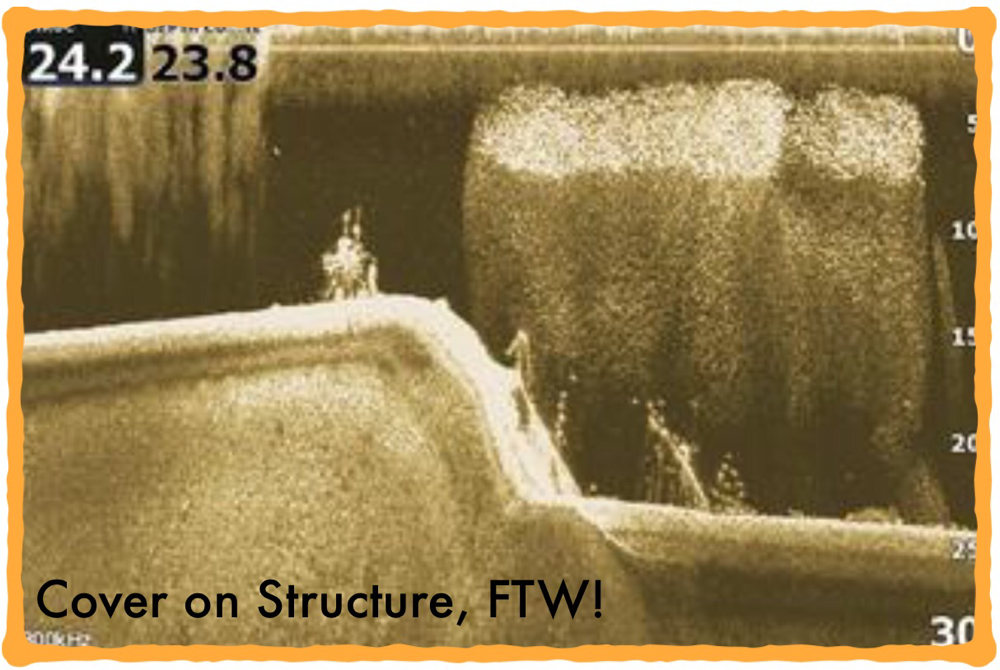
Structure vs. Cover:
       Words.  I like them.  You can do a lot with words, and words can do a lot for you; if you understand them.  Today we have a vocabulary lesson.
        The words "structure" and "cover" come up quite a bit when discussing bass fishing.  Seasonal migration routes, the spawn, and daily feeding habits revolve around these things.  But what are they?  Are they the same?  Do they relate?  Yes and no.  If you don't know the difference, don't worry.  There's a lot of confusion on the subject and even many pros disagree with other pro's definitions.  Hopefully by the end of this you'll have a better understanding and can even come up with your own definitions to argue.  I think the 2003 Bassmaster Classic winner Mike Iaconelli explains it best:  


         I like words.  But maybe you don't.  As an elementary school teacher on my fishing off-days, I know that people learn in different ways.  So for the rest of this blog, I'll part ways with the words and focus on the more visual-spatial learners:  
 

     I hope this has cleared things up for you.      

     Tight lines!

Tuesday, May 31, 2016

The 8th Way To Wren

The Jika Rig:

     About this time last year I wrote my first blog (HERE) sparked by the inspiration of my first pro-staff position with Cactus Wren Outdoors.  The topic was on all the various ways to rig Cactus Wren baits from deep to shallow, and power to finesse presentations.  If you read through that post, you may have noticed I left off two rather popular rigs: Texas, and Carolina.
      I did not simply forget about these bass fishing staples, I left them off for two reasons.  First of all, there's already so much information out there about these, I do not see the point in saying it all again.  Never in my wildest dreams will a Google search of "how to Texas rig" ever lead you to the dark and meaningless corner of the internet where my lightly treaded blog resides, so what's the point?
      Secondly, I just don't use those presentations very often.  Arizona isn't known for it's vast acreage of quality bass fishing waters.  The few areas that are productive are so over pressured that the bass have learned that these common presentations bite back (this of course comes from years of scientific studies from the University of My Ass, or UMA as it will from this point forward always be referred to).  To be successful in this bleak world of Arizona Bass Fishing, you've got to push the envelope, think outside of the box, [insert other ironic cliché here], and be progressive.  Since writing that first blog, I've been experimenting.  Now I'm ready to introduce the 8th way to Wren:  The Jika Rig.


1/4 oz left, 1/2 oz right

     
     The Jika Rig may not be news to you.  In doing a bit of Google research I've found articles and videos dating back four or five years.  Still, however, it's talked about very little compared to other soft plastic presentations.
     As you can see in the picture above, the Jika Rig is comparable to a dropshot in that the weight is below the hook.  Instead of being connected by several inches of line, it's connected by two small split rings.  This allows for the natural horizontal position that the dropshot is known for, but very near the bottom.  It is a similar presentation as a Texas Rig, but with some minor, but important, differences:


     The image above illustrates how the Texas Rig tends to pendulum forward as it falls.  I'm no physysist, but I do have a Bachelors of Science Degree from UMA.  From my intense research there, I have determined that the water resistance against the line pulls the weight forward at an angle which causes the bait to glide forward through the water.  With the Jika Rig, the weight leads pulling the worm and line behind it at a steeper angle.
      You can buy these rigs pre-made at any of the major retailers, but they are simple enough to make on your own with just a couple of split rings, a hook, and a dropshot weight.  This lets you further customize the rig with your preferred style of hook and weight, and costs much, much less of that hard earned money!  I just saw a pack in one of those big box stores today, seven bucks for a pack of two!  Let's break down this new and improved Texas rig with some suggestions for gear, baits, and locations:

      Just like a Texas Rig, the Jika can be thrown on just about any rod ranging from a light spinning rod to a heavy flippin' stick.  It all depends on the size of your bait, hook, weight, line, and of course location.


     For a finesse approach you could drop all the way down to a 1/16 ounce weight with a size 1 hook and a small two inch grub.  This presentation is going to be tough to cast on baitcasting gear, so a light spinning rod is the best option.  I like this finesse approach in the dog days of summer when the fish are deep and relating to underwater structure like points and humps.  As the size of your presentation grows, so does the need for heavier gear.
      I prefer two different set ups depending on a variety of factors.  For open water, or deep water presentations I will use a quarter ounce weight with a 2/0 EWG hook and a four to five inch strait or curly tail worm like the Cactus Wren Talking Stick or Quail Tail.  I'll throw this on a 7 foot medium spinning rod lined with 20 pound test braid and a few feet of 8 pound test fluorocarbon leader.  Bouncing this rig over rocky points during transition times like pre-spawn or late fall can be deadly for those big females looking to feed up before spawning or slowing down for the winter.


     As I move to shallow cover, I think along the lines of flipping and pitching.  My favorite area to flip and pitch this bait into, especially on hot summer days, is vast submerged grass flats.  Bass will hide in the thick oxygen filled cover in the heat of the day waiting for any food to stop by.  Flipping the Jika Rig along the grass lines, or in the pockets of grass triggers hard strikes from any bass that may be in the neighborhood.  I'll use a bigger bait like the 6 inch Quail Tail or a creature bait like the Canyon Craw.  Since I up the size of the bait, I up the size of everything else as well.  A half ounce weight pairs well with a 4/0 EWG hook and 12 to 15 pound test flurocarbon or monofilament.  If you're not comfortable with baitcasting gear, you can throw this on a medium heavy or heavy spinning rod, but I prefer a medium heavy baitcaster because I can flip and pitch the bait into multiple targets for more presentations faster than I can with a spinning reel.
      This is the same reason I like a fast 7:1 gear ratio reel.  When I'm working the shallows, I'm often picking apart individual pieces of cover.  If a bass is hanging out near a specific piece of cover, the strike zone is going to be relatively small.  He's there to ambush the prey, not chase it down.  After you've worked that bait for a moment near the cover, you can just bring the bait right back and cast out again.  There's very little chance of getting hit in the abyss between the cover and your boat, so a high speed reel will get that bait in quicker so you can get on with your next cast.


     Another benefit to the high speed reel is to pick up slack line before the hook set, and to keep tension on the line while fighting the fish if he makes a run towards the boat.  It may seem contrary to logic, but any time I'm slowly working a bait along the bottom, I want a fast reel for the reasons mentioned above.  There simply aren't any advantages a slow reel will give you with any bottom bouncing technique.
      With all that said, this is a very versatile technique.  Any rod and reel set up you have will get the job done in at least one situation or another.  Just remember to choose a size of presentation based on the gear you have available and you can catch fish!


    So go hit up Cactus Wren Outdoors and get all the soft plastics you need for the Jika Rig.  And as always, let me know in the comments or on social media if you stick a hog on this thing!

     Tight lines!

Wednesday, May 25, 2016

Feelin' Lucky: May 2016

Feelin' Lucky: May 2016
 
     "Feelin' Lucky" is a series of blogs posted on a monthly basis with the help of the folks at Lucky Tackle Box.  The point of these posts are two-fold; I'll be discussing a bit about Lucky Tackle Box, a great company that sends out subscription boxes filled with tackle each month from established tackle makers, along with some up and coming small businesses making their way into the fishing industry.  Secondly these posts act as in-depth fishing reports for the particular lake I go to each month.  Hopefully you and I will each learn something new along this endeavor.
 
Saguaro Lake: At 1,264 acres, Saguaro Lake is the fourth, and final, reservoir formed along the Salt River just east of Phoenix, Arizona.  Saguaro's steep canyon walls and average depth of 90 feet offer many challenges to bass fishermen searching for a big bite.  However, in the Spring bass move up to the shallow channel swings and coves to spawn where they can be caught easily on reaction baits of all shapes and sizes before returning to the deep cool water of their summer residencies.
 
 
     May's Lucky Tackle Box is jammed full of awesome spring reaction baits.  Yo-Zuri's 3DB Lipless Crankbait and the BD Series Spinner Bait can be worked quickly while covering lots of water fast to locate areas of active fish.  Once you find some fish you can slow down and zero in on the larger females with the Olympic Jointed Swimbait, or Biwaa's 3-inch Ultra Hog.  Toss the Fishing Physics #Geniusbait out to spawning fish on beds and you can have a hayday pulling in the males guarding beds (If that's your thing, of course).  My surprise bait in this box is the Rick Clunn Squarebill, another great shallow water search bait. 
 
     As great as this box is, I knew from the second I opened it that I was going to have a real tough time catching fish with it.  While across the country bass are spawning and feeding shallow in May, that's not the case here in the desert reservoirs of Arizona.  Here in our hot and dry climate, the bass move up to spawn starting in February.  By late April, most of the fish have already made their way to the cooler deeper water.  When I arrived to the lake at sunrise, the water temperature was 77 degrees and the bluegill had taken over any abandoned bass bed.  The bass were well on their way out of the shallows heading to their summer homes.
 
     I have seen rumors on social media and forums around the net that LTB is going to begin shipping boxes out based on region.  I sure hope this is true, as it cannot come soon enough!  Spawn just finished and this box already has me looking forward to next spring when I'll get more use out of these baits.
 
     Well, let's dive into the baits and see how I managed to do...
 
Yo-Zuri 3DB Lipless Crankbait:
 
     A red lipless crank is one of my favorite baits during the prespawn.  Paralleling the bank, keeping that bait running right along with the first drop off to deep water will catch you some big prespawn mommas all day long.  However, there are a few issues you run into during the summer transition:
 
1. The cray fish that it imitates changes to a green, or sometimes blue later in the spring.
2. The bass aren't in the mood to chase down their meal after spawning, they want it slow and right in their face.
3. As temperatures warm up, the coves begin to fill with thick weeds which are no fun for the treble hooks.  Ripping a lipless through the grass is one thing, but thick matted weeds is a different story.
 
     I did my best slowly yo-yo-ing this bait along the submerged weed lines and burning it across the top of the grass trying to tempt those post spawners out of the grass to eat, but to no avail.  I think a shad or bluegill color may have stood a better chance of getting hit.  Although this bait is ready to fish right out of the package, I wanted to use everything in the box so I put the Mustad Ultra Point treble hooks on it.  The short shank on these hooks made it a bit easier to pull through the heavy grass and weeds.


     I didn't open this bait yet, I'm saving it for something special.  Hopefully I'll have good things to report on it next month when I return from a week long trip in Colorado.
 
 
Rick Clunn Squarebill:
 
     Another one still in the package.  The weeds were simply too far along in their plot to take over the world, and the window for any potential reaction bite is just too narrow this time of year.  I chose the Yo-Zuri bait because I knew that, despite the color, it would stand a better chance in the submerged weeds.  This guy will probably stay in it's package until October or November as the weeds die off revealing the rocky bottoms and standing timber that's currently hidden away.
 
Olympic Jointed Swimbait:
 
     Oh how lucky this particular Lucky Tackle Box was, I got a second one thrown in by mistake!  Although I'm not entirely sure what fish this bait is supposed to imitate, it's a cool bait!  It's a sort of hybrid bait between the panfish bait in last month's box, and a squarebill.  I didn't throw it a lot for two reasons: 1.  The weeds, again, those dang weeds...  2. There's nothing in Saguaro Lake that looks like this; maybe a green sunfish, or possibly a yellow bass, but not quite enough to give me much confidence in it.
 
     I'm curious if any of my Arizona readers have had luck at Lake Pleasant with something like this.  It sort of resembles a small striper.  Tossed around the shallows in the spring or fall you may have some luck at a big largemouth or non-schooling striper.  If you have, let us know in the comments!
 
Fishing Physics's #Geniusbait:
 
     A picture is worth a thousand words, so in lieu of my thousand word criticism, I'll just leave you with that picture above.
 
     I do, however, want to point out one positive about this bait; the scent!  Despite the lack of many fish catching qualities of this bait, it still attracted the attention of the few fish I could still see up shallow and I think that had to do with the scent.  My package was the "earth worm" scent, and it was a smell that I've yet to come across in any other soft... or not so soft... plastic.
 
   
     I experimented quite a bit with this bait trying to get bit on this worm.  It's designed as a wacky worm like the ever so popular Senko, but when that failed I had to get creative.  I tried it deep on a Carolina rig, on a mojo rig in the submerged grass, on a shakey head, and even cutting it in half for a drop shot, and Ned rig presentation.  With this color, LTB had bed fishing on their minds, and I'm positive that if there had been any bass up on beds, this would have gotten the job done.  Especially with that earth worm scent!
 
Biwaa Ultra Hog:
 
     I don't know why this is called an "Ultra Hog".  That sounds like a big beefy bait.  At 3 inches, this is more of a "micro-finesse piglet".  That's my only criticism of this bait though!  I saved this bait for last because even at high noon I knew I could find a bite with it as the only bait in the box I have confidence in during this summer transition.  A small, compact, creature bait like this can be used in a variety of ways from flipping into dense cover, to dropped onto deep underwater structure.
 
     To start, I rigged the Ultra Hog on a dropshot set up to fish the submerged grass lines in about 12 feet of water.  Ultimately, that would be the only rig I would need, because after six hours of frustration with the other baits, I hooked into this solid Saguaro Lake bass on the second cast.
 
     Before we wrap up, I want to take a moment and talk about dropshot and the length from the hook to the weight.  As you can see in the picture above, I started with a length of about 12 inches.  That length will vary quite a bit depending on location, bait type, and season.  It should also change often as you are zoning in on where the fish are in the same way that you would change out crankbaits every few casts until you find the one the fish want.  Way too often I see guys throwing the same presentation for hours on end without any bites.  Doing the same thing over and over again while hoping to expect different results.  No.  Change something.  Change the size of the worm, change the lengths of the leader, don't re-elect incumbents who have a history of not getting anything done in Washington, change the color of the bait, slow down, speed up.  Just as we demand our congress men and women should have term limits, our failing bass presentations should have limits as well.  So change something, anything!
 
 
     For more on all the baits in this month's box check out Lucky Tackle Box HERE, and for in depth how-to videos subscribe to the LTB YouTube channel HERE!  You have about a week left to sign up for LTB in time to receive June's box, so get over there now to sign up and start feelin' lucky this summer!
 
Tight Lines!
 

Wednesday, May 18, 2016

Bass Fishing 401

Bass Fishing 401:


     I see a lot of "Fishing 101" articles, and videos, and blogs, and vlogs, and pogs, and even a shmog or two about the basics of fishing.  But this isn't an entry level course on fishing (or grammar for that matter, just look at all the rules I've broken in these first two sentences!). This is the 400 level.  The point in your education where the pupil becomes the master.  Where you are trusted with the responsibility of taking a new human mind under your wing, to form a student of your own in the likes of your self.  To pass down not just knowledge of a game, but a legacy of champions.  A student that will one day grow into a master himself.  More powerful than you could ever imagine.  A master, who fueled by fear and suffering, turns to his powers to cheat death and save the life of his beloved baby momma.  A master with a false hope that his power of this force can be used for good.  To rise and unite the galaxy as one under the Galactic Emp....  Wait, no, that's Star Wars.  Fishing.  We're talking about fishing....

     What I'm trying to say is, this discussion is not about you.  You already know how to fish.  This is about teaching others.  And let me make one thing clear, sharing this article to your rookie friend is not going to teach said friend to fish.  That's right, in a cyber world of shares and viral media, I'm telling you NOT to share this article!  Instead, use it to share YOUR knowledge.  Use it to pass down a lesson the way education is supposed to work, through real life human connection.

     Throughout this article, I've emphasized with bold some of the more specifically educational points.  These points are important to keep in mind throughout the whole process, and even when teaching non-related fishing items.  I spent WAY too much money on used text books in college, and these are the kind of things that were already highlighted in them.


Lesson 1:  The Bobber Rig

     If your student is a 5 year-old child or a girl you met on Tinder, then this is a great place to start.  If your student is anything else there's a better way.  In short, "Lesson 1: The Bobber Rig" is don't use the bobber rig.


     For most people, staring at a bobber is boring.  Its a common theory among childhood development experts that children have an attention span of minutes equal to their age.  This means that a six-year-old can focus on that bobber for about six minutes before he'll get bored and grouchy.  However, in my experience, working with children everyday from ages 5 to 12 as an elementary school teacher, this pattern cuts off at about 10.  Anyone older will have their cellphone out texting, or on Instagram, before the bobber even hits the water.  I can't tell you how many teenagers I've met who were turned off to fishing because they learned with a bobber but weren't old enough for the beer that MUST accompany this kind of fishing.


Lesson 2: Equipment

     Working with big, heavy equipment can be difficult for someone first learning.  Regardless of if they are learning with spinning gear or a *baitcaster, downsizing the equipment will help them to feel more in control of it.


     I'd recommend a medium power, fast action rod not over 7 feet long.  Carrot Stix (as shown in the photo above) make some great rods for every level of angler from novice to pro.  The carrot-based fibers that give the rods their name translates to a rod that's both lighter and more durable than many rods on the market making them a great choice for a beginner that's going to be rather tough on a rod.  You can find more info on Carrot Stix HERE if you're in the mood for an orange rod!
     
     Whatever rod you choose, spool it up with a high quality mono-filament line around 10 to 12 pound test.  Trying to cast the cheapest line from the bargain bin at Walmart is difficult for the best of us, it's not going to make casting for your student any easier either.  However, don't use high priced braid or fluorocarbon.  You are going to be dealing with a lot of birds nests, loops/tangles/knots, and nicks in the line from casting into trees, bushes, rocks, fences, and anything else that may be up on the shoreline.  After just a trip or two, that line may be ready to be replaced.

     Set your pupil up with a small tackle box of a variety of "do-nothing" and "cast-and-wind" lures.  Examples of a do nothing bait would be something like weightless wacky worms and shakeyheads.  These are lures that you cast out and let sit for longer periods of time (but not so long as to bore the student).  Lures that you may relate to the term "dead sticking" are great choices.  Cast-and-wind lures are generally reaction baits like crankbaits, spinnerbaits, and small swimbaits.  Basically, you want to avoid any kind of presentation where you have to impart your own action on the bait.  The student has enough things to worry about at this stage, cadences and whatnot are just going to over complicate and confuse them.

*Don't be afraid to start someone with a bait caster.  I learned to fish with them when I was about 7 or 8 years old, a teenager or older certainly can too.
**But definitely avoid the spincast reels.  Not only do they tangle up and break all the time, they teach bad habits.  The release point is at a very different time than other reels, and the locomotor movements within your hands and thumb are opposite of others.  Just like the bobber rig, unless you're teaching a five-year-old, just say no to spincasts.


Lesson 3: Casting

     If you can't cast, you can't fish.  Teaching someone to cast is the MOST IMPORTANT PART (I capitalized that for those of you that skim through these and may miss something)!  Your student simply won't catch a fish if they're only casting 15 feet in random directions.  I can't stress this enough, casting should be the number one concern for both the teacher and the student.  This lesson should be broken down into two smaller lessons: distance and accuracy.


Distance:

     This is the time for your cast-and-wind baits.  Spinner baits like the Boyd Duckett BD Series Spinner Bait, Yo-Zuri 3DB Lipless Crank, and the Olympic Lure's jointed swimbait are all great cast-and-wind lures that won't run too deep and get snagged on the bottom.  These lures, plus many more, can be found in this month's Lucky Tackle Box.  Check them out HERE if you are so inclined.
     The key is repetition.  The more casts you can get in each trip, the more practice they will get at it, and the more progress that will be made.  Even if the fish aren't on a reaction bite, keep hammering away with those cranks and spinners.  It's not about what's best for the fish, but what's best for the student.
     Find some off-shore structure to fish and place a marker buoy out on top of it.  Tie on a crankbait that runs just deep enough to get down to the structure, but not more.  It doesn't need to drag the bottom or get hung up in the brush piles, remember the focus is casting, not catching.
Position the boat about 30 feet off the marker.  The goal should be to cast past the marker, not to it.  At this point, we're working on distance so the marker is a goal, not a target.  As needed, back the boat further away from the marker until they can consistently reach 50 to 60 feet.
     Don't force a technique on them, let them figure out what's most comfortable.  A two handed over hand cast might be the best way to get distance for you, but maybe a slinging side arm cast is the most comfortable for them.  Let them discover the tweaks they have to make to all the little details of the cast.  Explaining every last thing to them and nagging them about every detail is just going to ruin it for them.  After all, everyone casts a little bit differently anyway.  As long as they don't look like Charles Barkley's golf swing, they're going to be just fine.

Accuracy:

     Tie on something small and compact, but heavy enough to cast pretty easily.  This is a time for those "do-nothing" baits.  For a baitcaster I'd recommend something like a jig or a Texas-rig from about 1/4 to 1/2 ounce.  A small shakeyhead worm or weightless 5-inch Senko would be a good choice for spinning gear.  Cactus Wren Outdoors, HERE, makes a great little shakyhead jig head.  Pair the Rock Hopper up with a 5-inch Quail Tail or Talking Stick soft plastic and you have a great little compact, weedless, fish-catching thingamabob (Yup, a thingamabob).  Whatever you choose, make sure it's weedless!  Your student is going to be throwing that lure into all kinds of crap on the shore line, and it's your job to go dig it out.  The more exposed the hook is, the tougher it's going to be to get it out of those tullies.
     Find a location along the shore that doesn't have too much vegetation, rip-rap banks work great.  Have your student pick a rock around the shore line and cast to that rock from different angles.  Each angle will slightly change the distance as well.  This is important!  Accuracy is not about just hitting your target from left to right, but distance as well.  It doesn't matter how well you can cast along the X-axis if you're constantly over shooting (or under shooting) your target.
     Once they feel comfortable controlling the distance, move on to some isolated cover.  Stumps and stickups on shallow flats are great high percentage areas that give them a great chance to get bit at this early stage.  Have them focus on casting to either the left or right of the target, but not directly on it.  Not only will this mean less hang ups, but the larger target will give them more confidence.  Missing their target (a tiny little stick) will discourage them, but casting into the larger area will make them feel more comfortable.
     Use this time to tell them a bit about the bass's feeding habits or seasonal patterns.  These habits are why accuracy matters.  The "why" is important to motivate the student.  Were you the kind of student in school that put less effort into math class because no teacher could ever tell you why you needed to know logs, factoring, and the quadratic formula to succeed in life?  They probably were too, and maybe still are.  So consider the conditions.  Is there current where you're fishing?  Bass will be on one side of the cover or the other based on current.  Post front conditions?  Bass will be holding closer to the cover, and accuracy is more important.  Is there shade on the water from docks, cliffs, trees, clouds?  Bass will be more willing to leave the cover and chase down baits so accuracy isn't as important.

Lesson 4: Setting the Hook

     Unfortunately this is a situation that you can't recreate on your own.  It's also not a situation that occurs all that often on its own.  The K.I.S.S. method is important here, and no I'm not referring to Jimmy Houston kissing each fish.  There are a ton of acronyms in the education world, but none as important as KISS:  Keep It Simple, Stupid!


The process should go something like this:

1. Feel something on your line?
2. Lift the rod tip up and reel in!

It really is that simple, stupid.

     This isn't the advice I give to advanced anglers.  An advanced angler should know that various types of lures need different types of hooksets in order to increase your hook up ratio.  And I absolutely loath the sayings "when in doubt, set the hook" or "hooksets are free".  In my opinion they are just wrong, wrong, WRONG!  But that's another article...  I regress...  In this instance, if anything feels different, have them set the hook!

     Keep it simple with regards to step 1:  "I don't know what a bite feels like."  So set the hook on everything.  If your student feels something and sets the hook on nothing, now they know that's not what a bass feels like.  Eventually they will feel something and set the hook to find a bass on the other end.  That's what a bass feels like!  In order to learn it, they have to experience it.

     Keep it simple with regards to step 2:  More times than not, a bass will hit a lure and swim down.  To set that hook and turn him around, you want to put opposite resistance on that hook point, so pull him up!


Lesson 5:  Landing the Fish:

     Don't be a jerk, get down there on your knees and grab it for him!  One of these days he'll feel confident enough to grab yours for you.  That's the sign of a true partner. (Are we still talking about fishing?)


     Seriously though, don't be a jerk.  This might be a long time friend and you've busted each other's balls all your life.  Maybe it's a buddy from work that you always give some crap to in the break room.  But by agreeing to let you teach them something, they've put themselves in a pretty vulnerable situation. Now isn't the time to be tough on them.  Be cool.


Lesson 6:  Be Sure to Catch Fish

     Success breeds confidence and confidence breeds success.  Take your buddy fishing to a place, and on a day, where you know you can catch fish.  No one likes getting skunked, especially when they're first learning.  Catching fish from day one is a huge confidence boost and will make them want to go out again and again.  You've only got one shot at that first impression.  If their first impression is "we fished for 7 hours without a bite, all I got was this sun burn," it's going to be real hard to convince them to go out a second time.


     It's important that YOU catch a fish or two as well.  A good teacher needs to be a master of the skill.  The old saying "Those who can't, teach" is complete nonsense!  Teachers need to be able to show examples and prove their knowledge and skills to the student.  As a student, it's awfully hard to respect the teacher and learn from them if you don't really believe they are a master in the first place.


Lesson 7: The Retrieve

     It may seem a bit out of order to be discussing the retrieve after hookset and landing, but remember that up to this point your student should should only be using simple cast-and-wind lures, and do-nothing lures.  Retrieving different types of lures in a variety of ways is a relatively advanced topic.  Lesson 7 probably won't be discussed until a few trips in when your student has already mastered distance and accuracy.


     Obviously retrieving the lure will depend on what the lure is.  A wacky worm is worked in differently than a spinner bait, a craw imitation bait is retrieved differently than a shad imitation.  When explaining the retrieve, start from the end-goal.  Teaching from the end to the beginning is huge in the education world, we call it "backwards design".  The theory is that the student will have a better understanding of the process if they already know the end result.  They may even fill in the blanks on their own!

So what is the end result?  Well, it depends on what the lure is.  A Texas-rigged Rage Craw's end result is to look like a crawfish.  Crawfish swim, or bounce if you will, in quick short bursts backwards.  That's what should be explained to the student.  If they understand how the real life prey works, they can figure out on their own how to make the lure do that (by quick pops of the rod upwards).  If you simply tell them to quickly pop the rod upwards, it gives them a lot of variables to guess at (How quickly?  How far of a pop?  How often do I pop?).  If you explain to them and show them how the bait moves, they can figure out the finer details on their own.

     The same goes for any lure!  Start with the end.  What are you imitating?  What does that look like?  Then go find some clear water and experiment until your student figures out what to do


Final Thoughts:

-Your student should be fishing more than you do!
- If you're out on a boat, don't stick them in the back seat the whole day!
-Teaching is a tiring activity, you need to constantly be involved with your student's progress.  Keep and eye on each cast.  Compliment every success and criticize each mistake.
-Keep the lectures short and to the point.
-Keep them active, repeating cast after cast, success after success.
-Make that first fish the biggest deal in the world!  Doesn't matter if it's a half-pound dink, or a six-pounder.  A first fish is reason to celebrate!

     Most importantly, it doesn't matter how old someone is.  They're never to old to fish for the first time.  And despite the picture at the start of this post, fishing really isn't that easy.  A helping hand can go a long way!

     Tight lines!